How Paramark accounts for lag across Incrementality Testing & MMM
Last updated: September 17, 2026
Finance and marketing leaders often ask a very reasonable question:
“If marketing’s impact shows up over time—not instantly—how does Paramark adjust for that delay when measuring incrementality?”
In marketing science we call this delay lag, and in practice it shows up in two related phenomena:
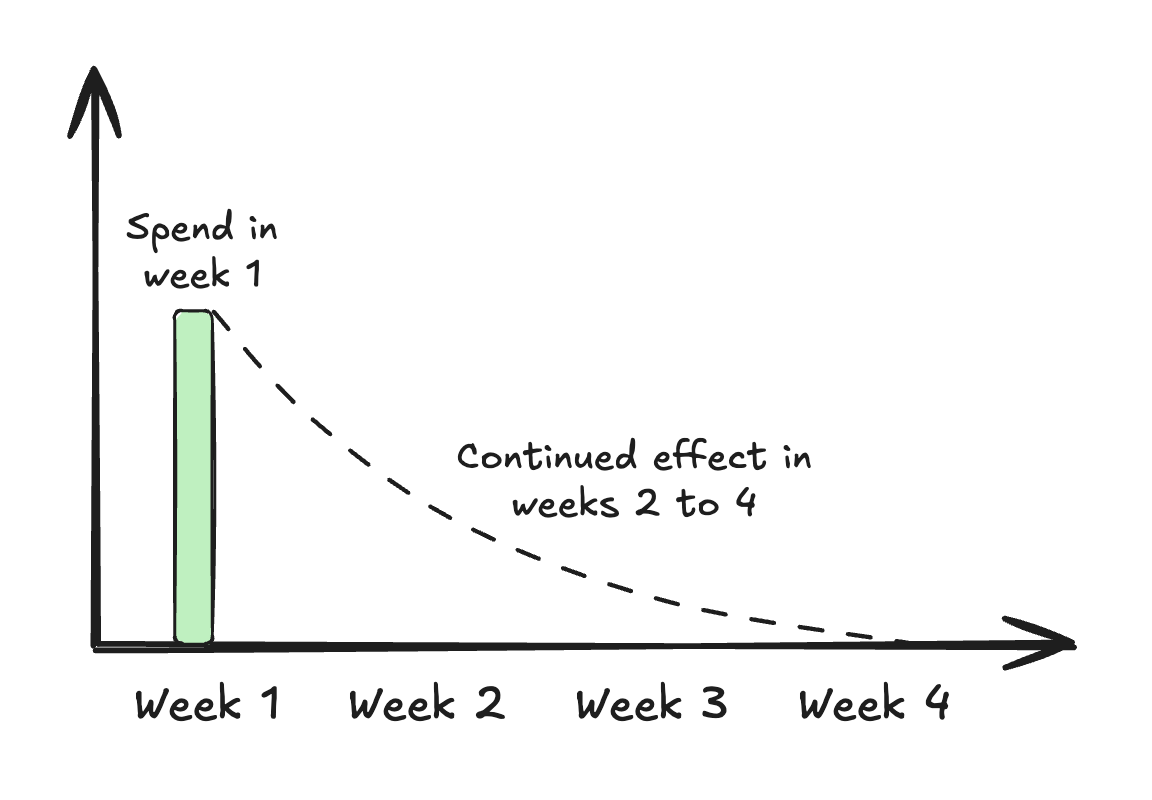
Carryover – the portion of impact that continues after spend stops
Adstock – the statistical mechanism we use inside MMM to model that carryover effect
This article explains how Paramark handles lag across Incrementality Testing and Marketing Mix Modeling (MMM), why the approaches differ, and how we unify them into a single consistent understanding of causality.
Our goal: Make stakeholders comfortable that Paramark is not under- or over-counting the true impact of marketing, especially when effects unfold over weeks or months.
1. First principles: What is “lag” in marketing measurement?
Think of lag as the space between when marketing spend occurs and when consumers or buyers respond.
Examples:
A user sees a campaign today, Googles you next week, and purchases two weeks later.
A promo email goes out Monday, but revenue shows up Saturday/Sunday when customers have time to buy.
A brand TV flight lifts organic search volume for ~8 weeks after the campaign ends.
Lag is real, but not uniform. Different channels create different lag structures.
Illustrative channel / tactic lag pattern | |
Paid Search | Immediate, 0–3 days |
Meta direct response / retargeting | 1–7 days |
Meta prospecting | 7–14 days |
TV / OOH | 4–12+ weeks |
Because lag varies across channels, we need rigorous, defensible ways to account for it in both experiments and MMMs.
2. How Paramark accounts for lag in Incrementality Testing
Incrementality testing measures causal lift by comparing a treatment group (exposed) to a control group (unexposed). Because we observe actual consumer behavior, we can measure lag with high fidelity—but only within scientifically valid boundaries.
A. Choosing the appropriate test window
Paramark test designs are built to capture the full expected effect of a channel.
For channels with lag, the test window is designed long enough for effects to emerge.
Examples:
SEM tests: often 2–4 weeks
Awareness tests: 6–10+ weeks
If a customer wants a short test for a long-lag channel, we will flag that the window is insufficient to capture the full effect.
B. Post-treatment “cooldown” windows
Even if spend stops on the final day of treatment, behavior doesn’t stop. So Paramark optionally includes post-treatment windows to capture delayed impact. There's potential for mixed results here if the test windows become too long since its hard for teams to maintain exposed/control groups accurately for too long.
C. Avoiding bias from early peeks
An early peek at the data is almost assuredly going to be inconclusive. Early peeks distort lag measurement because:
Treatment effects haven't fully materialized
Control/treatment noise overwhelms true lift
Finance teams may incorrectly conclude a campaign isn’t working
Our stance: Lag can only be measured correctly once the full designed test duration—and cooldown if applicable—has elapsed.
3. How Paramark accounts for lag in MMM
Incrementality tests give direct causal measurement. MMM works differently: it must infer causality from correlations in historical spend and performance data. To correctly represent lag in MMM, Paramark uses:
A. Adstock — the economic model of diminishing delayed effects
Adstock mathematically encodes the idea that marketing doesn’t act only in the week it is spent. Instead:
Effects peak slightly after spend occurs
Effects decay over time, often exponentially
Different channels have different decay shapes and speeds
How Adstock Works Conceptually
Imagine a channel with weekly spend:
Week 1: $10k
Week 2: $10k
Week 3: $0 (paused)
Consumers still respond in Week 3 because prior weeks’ exposure persists in memory and behavior. Adstock models that “memory” curve.
Why MMM Needs Adstock
Without adstock, an MMM would falsely conclude:
Search revenue spikes only because we spent this week
TV lift appears only during the flight
Organic revenue fluctuations have no relation to prior marketing
With adstock, MMM correctly attributes the lingering (aka halo) effects from any channel over time.
B. Carryover — the real-world phenomenon Adstock is modeling
Carryover is the human-behavior side; adstock is the mathematical side.
Carryover = “people don’t act instantly”
Adstock = “so our model must delay and decay the impact”
The size of the carryover window varies dramatically:
ChannelTypical Carryover | |
2–5 days | |
Search | 0–3 days |
Paid social DR | 3–10 days |
Paid social prospecting | 2–6 weeks |
TV / OOH | 4–12+ weeks |
Paramark identifies adstock parameters (peak offset δ, decay rate λ) based on channel structure, customer behavior, and data patterns.
C. What MMM Does Not Do With Lag
It does not assume unlimited brand carryover (capped at ~13 weeks)
It does not assume the same lag across channels
It does not assume instant revenue recognition
It does not let adstock overpower more direct channels
4. How incrementality testing & MMM work together to handle lag
Paramark uses a combined approach.
A. Experiments give clean causal readouts of lag
When a channel’s true lag behavior is observable via testing, Paramark can use the results to:
Validate MMM’s adstock assumptions
Adjust MMM priors (when an experiment strongly contradicts the model)
Reduce uncertainty in MMM’s carryover estimates
This is especially important for long-lag channels (brand, TV, prospecting).
B. MMM gives the long-term, macro view that experiments can’t
Experiments cannot practically measure:
Multi-month lag beyond 2–3 weeks reliably
Halo effects across channels
Interactions between marketing and seasonality
Sustained baseline shifts
MMM fills this gap with adstock + regression structure.
C. Unified interpretation for stakeholders
Together, experiments and MMM provide a complete accounting of lag:
Experiments confirm short-term causality; MMM quantifies long-term effects.
5. Frequently Asked Questions
Q1. Why don’t we always include long “post-periods” in experiments?
Because noise grows exponentially the longer you extend a window, reducing clarity.
MMM is a better tool for long-lag measurement.
Q2. If MMM already accounts for lag, why do we need experiments?
Experiments validate channel incrementality and help calibrate adstock when data is ambiguous.
Q3. Do adstock curves tell me exactly when revenue will occur?
No—the curves represent relative decay of impact, not exact daily revenue timing.
Q4. Does Paramark let brand spend receive infinite carryover?
No. Carryover is mathematically capped and aligned to customer-specific evidence.
Q5. Does lag ever cause “double counting” between months?
No. Adstock redistributes lift over time, but total lift remains the same.
Q6. If LinkedIn or another prospecting channel peaks several weeks after impression, how long should we run the experiment?
Use the expected lag to size both the treatment window and the readout window. If a prospecting channel typically peaks around 3–3.5 weeks after impression, a very short test will undercount impact because the response has not fully emerged yet.
As a practical rule, we usually recommend running the treatment long enough to create a measurable signal and leaving room for a short post-treatment observation period. For example, a channel with a later peak may require roughly 6 weeks of runtime plus a cooldown/readout period afterward so delayed conversions can be observed before calling the result.
The exact duration still depends on your business, conversion cycle, and how noisy the metric is, but the principle is consistent: do not judge a long-lag channel on a short-lag timeline.
Want to learn more? Check out other Paramark articles here