Preparing for your Paramark Kickoff
Last updated: October 23, 2026
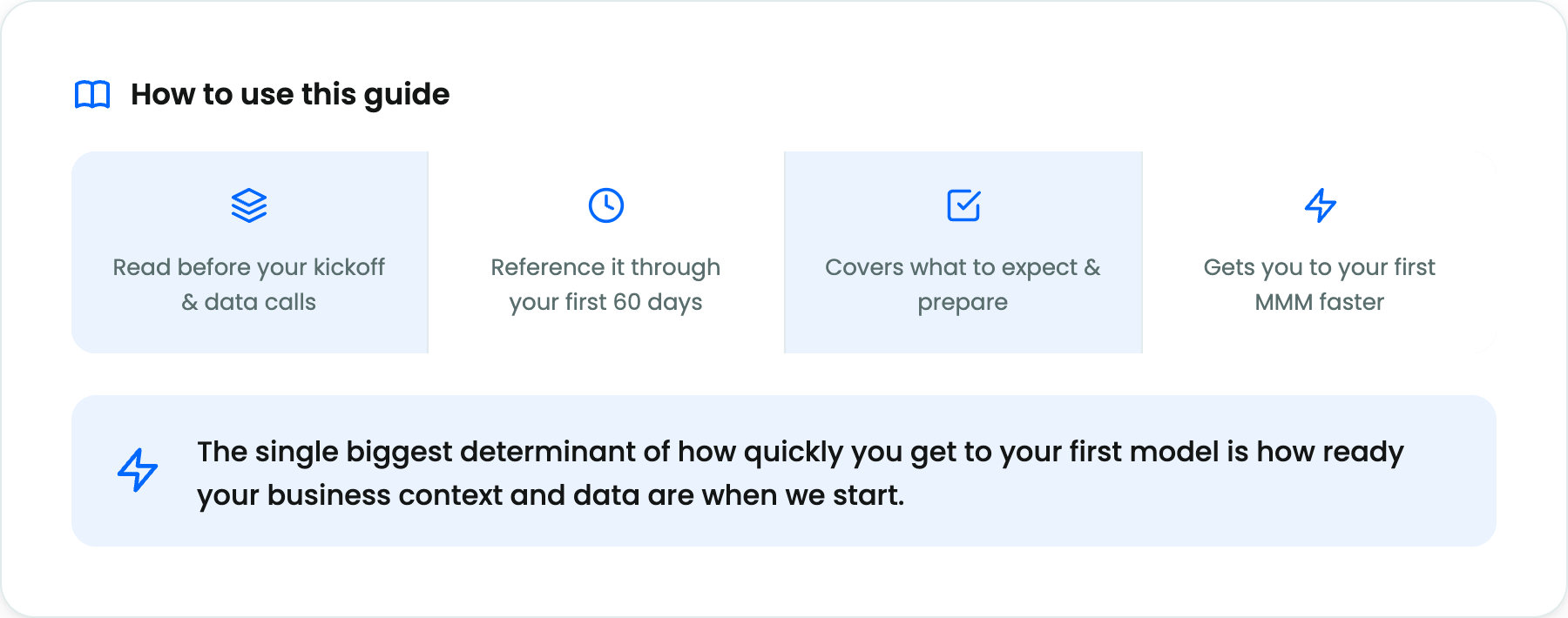
What to expect and how long it takes
Your Growth Advisor will work with you to understand your business, align on goals, and get the data we need to build your first model. Most customers move from kickoff to first MMM or experiment design in 45-60 days. Some move faster. Some take up to 6 months. The variable is almost always data readiness.
The largest dependency is on the state of your data (quality), how quickly all data is shared and responsiveness as we align on what we should see in your data
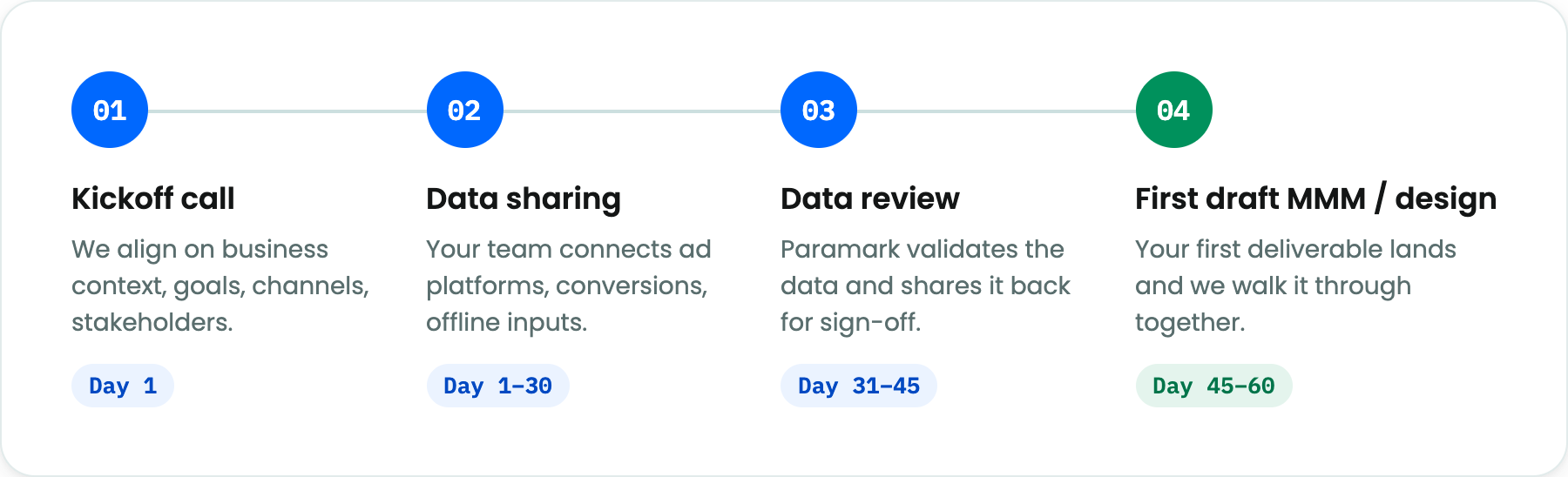
The customers who hit the shorter end of this range have three things lined up before kickoff: a clear owner on the data team, executive alignment on the goal metric, and a named contact who can speak to each paid channel. You can go even faster if you’re able to populate the data documentation and answer the understanding your business questions.
Legal and commercial readiness before kickoff
For many customers, one of the last pre-kickoff steps is confirming that the required legal paperwork is complete. That often includes an NDA, and in some cases a DPA or related procurement paperwork depending on how your team shares data and how your legal process works. Once the relevant documents are signed by both sides, that is typically a useful milestone because it clears the way for more detailed onboarding coordination and information sharing.
What usually happens next is straightforward:
Your Paramark team can move forward with onboarding coordination, including scheduling kickoff and data onboarding conversations.
You can begin preparing the practical materials for kickoff, such as identifying the right attendees, confirming your target metric, and gathering information about your data sources.
If there are any remaining internal approvals on your side, it is helpful to flag them early so they do not delay scheduling or data access once the NDA is complete.
If you are unsure whether anything else must be completed before kickoff, the fastest path is to ask your Growth Advisor whether there are any remaining onboarding prerequisites beyond the signed NDA.
If your contract is fully executed, are you ready to get started?
Usually, yes — a fully executed agreement is the clearest signal that both sides can move into onboarding coordination. In practice, that normally means Paramark can proceed with kickoff scheduling, data onboarding conversations, and the initial handoff to the teammates who will run implementation.
To keep momentum high, the best next step is to confirm three things internally: who will own the day-to-day onboarding work, who can speak for your data sources and paid channels, and whether there are any remaining approvals or access dependencies that could still slow kickoff after the contract is signed.
If all three are in place, you are typically ready to move forward. If not, you can still tell Paramark that the contract is complete and note any remaining logistics so the team can plan around them early.
If you've signed the DPA and already shared your initial data
That is a strong onboarding milestone. Once the legal paperwork is complete and your team has already sent an initial spreadsheet, data catalog, or warehouse details, the next step is usually not to resend everything from scratch — it is to help Paramark validate what was shared and identify any gaps quickly.
A practical next step is to confirm:
which file, sheet, or warehouse location should be treated as the current source of truth
whether the shared data is complete enough for initial validation or if some channels, metrics, or historical periods are still coming
who on your team owns follow-up questions if Paramark finds a schema, access, or completeness issue
whether kickoff can proceed in parallel while the remaining data details are cleaned up
In practice, this usually means Paramark can start by reviewing the material you already shared, confirm what is usable, and then tell you exactly what — if anything — still needs to be added before the first modeling or onboarding work continues.
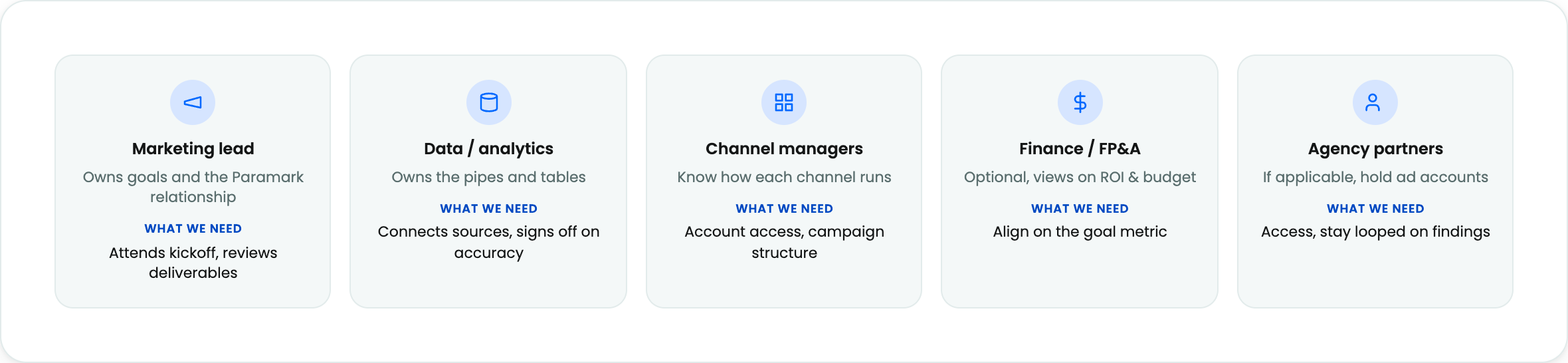
Who on your team needs to be involved
Onboarding goes faster when the right people are identified early. You don't need to pull everyone into every call, but each of these roles has a job to do in the first few weeks.
Getting Started: Kickoff call and Data onboarding (parallel workstreams)
What the kickoff call looks like
The kickoff is a 45-60 minute working session. Your Growth Advisor, your Paramark Onboarding Lead, and your team will focus on understanding the ins and outs of your business and data.
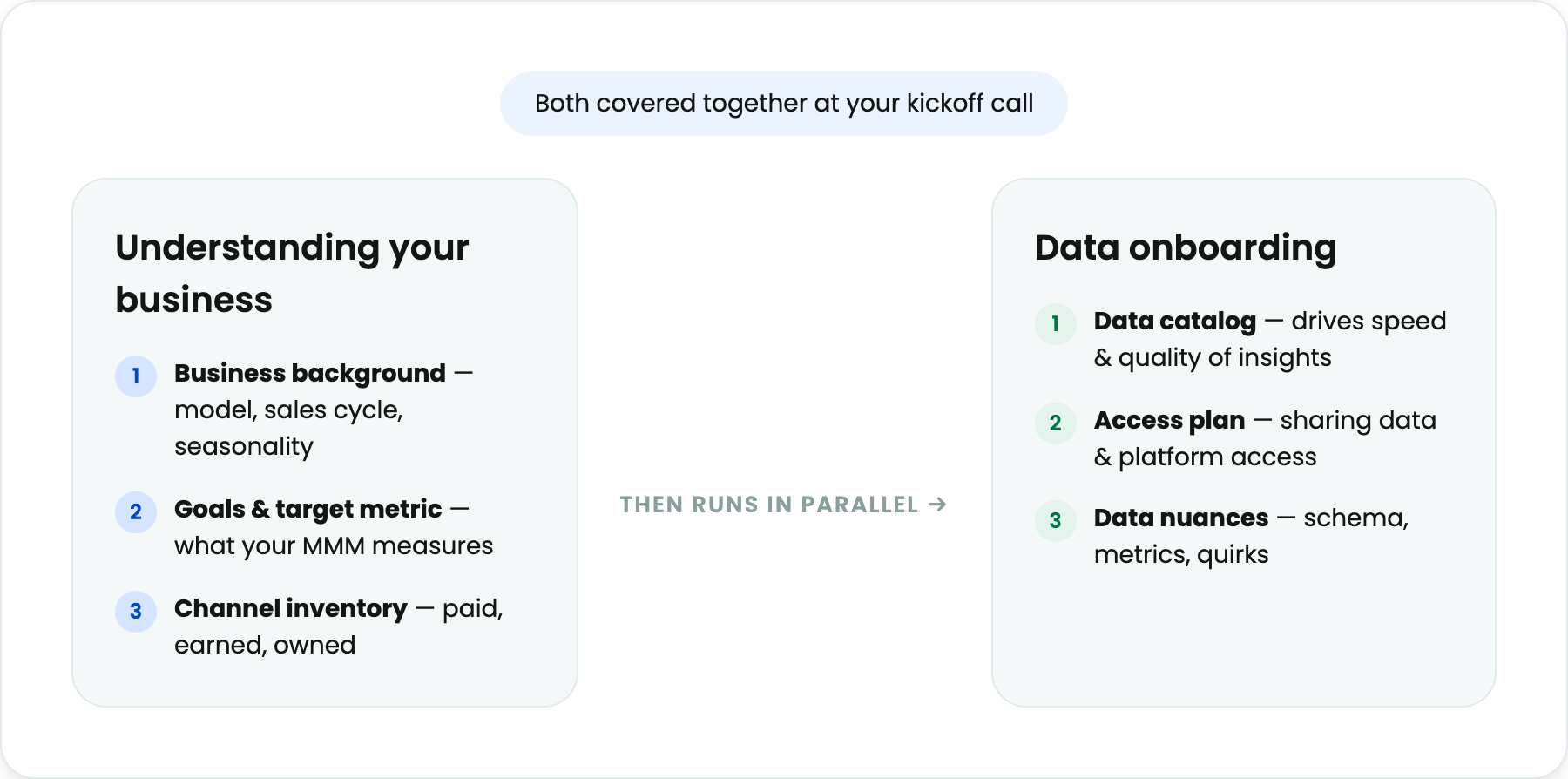
The more context you provide the more productive the kickoff call and faster we can move to deliver value. It is imperative that we have the right team members in the conversation so that we can answer the questions and quickly move forward in onboarding.
We will send you the data documentation as we setup our onboarding calls. Please populate what you can as it will accelerate the process.
A simple pre-kickoff questionnaire
If you want to speed up the first meeting, come prepared with answers to these questions:
Who should join? Please include the marketing lead, the person closest to the data, and anyone who can speak for your major paid channels.
What is your primary success metric? Examples include qualified leads, orders, pipeline, or new customers. It helps to know the rough weekly volume and how quickly marketing tends to influence it.
What channels are in your mix today? Please list the platforms where you actively spend, plus any important splits such as brand vs. non-brand search or prospecting vs. retargeting.
How is data shared today? Let us know whether the data lives in a warehouse, ad platforms, spreadsheets, or a mix of sources, and who owns access on your side.
Do you have location-level data? State, DMA, region, or country-level detail can be especially helpful for future incrementality testing.
Are there any major business factors we should know about? For example: seasonality, promotions, new market launches, product changes, or other events that may affect demand.
Do you have past experiment results we should be aware of? Previous experiment results can help inform the model. In some cases the information may be dated and/or the experiment may not have been controlled; but it's helpful context that we can consider when building your model and experiment roadmap.
If you can answer even part of this questionnaire before kickoff, we can spend more of the meeting on decisions and less on back-and-forth follow-up.
What to prepare before kickoff
This is the part of the guide worth spending time on before the call. Every minute you invest here saves days later.
Your target metric
One of the most important decisions we make together is which metric your marketing mix will be measured against. The right metric is the one most directly influenced by your marketing spend, with enough daily volume to model reliably.
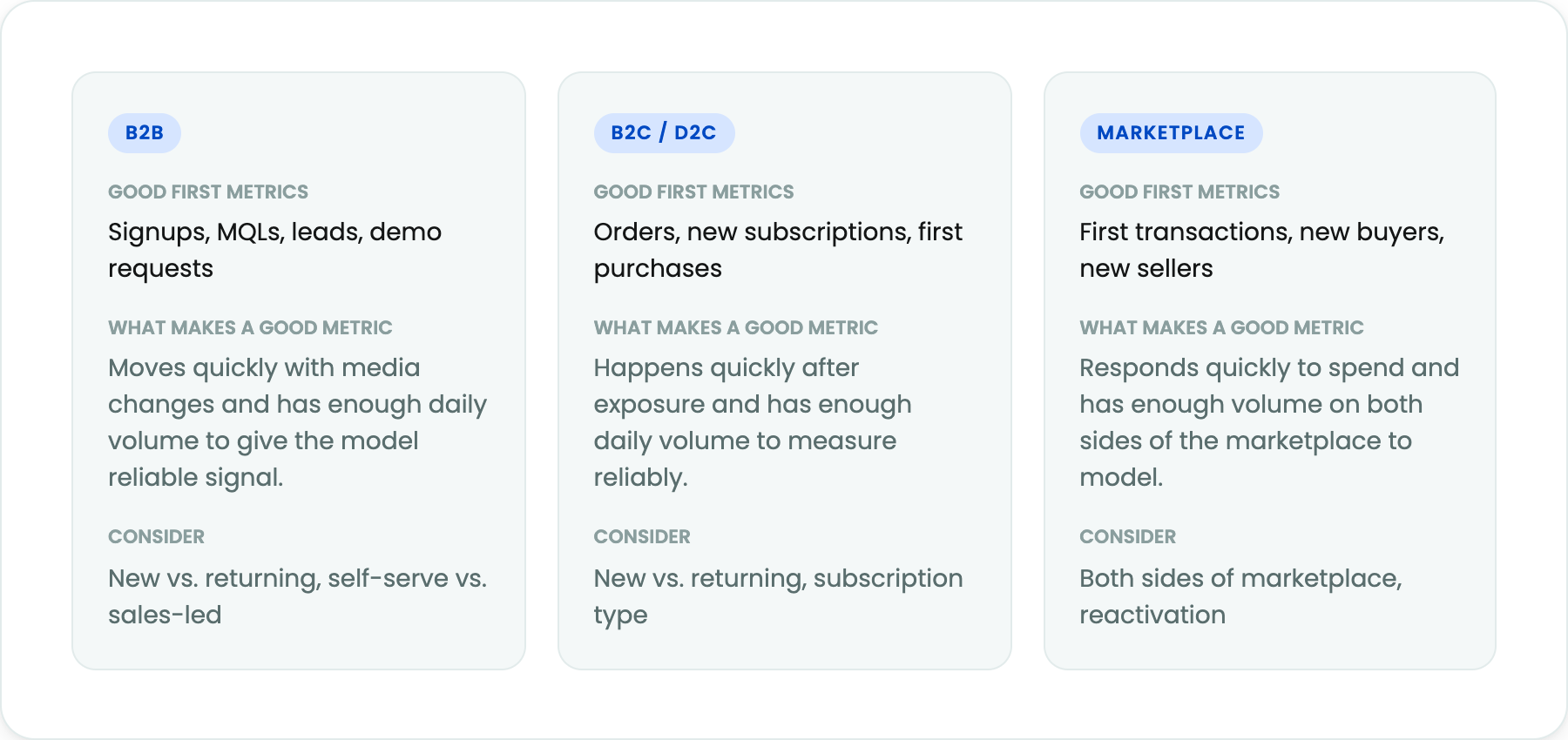
Be ready to answer:
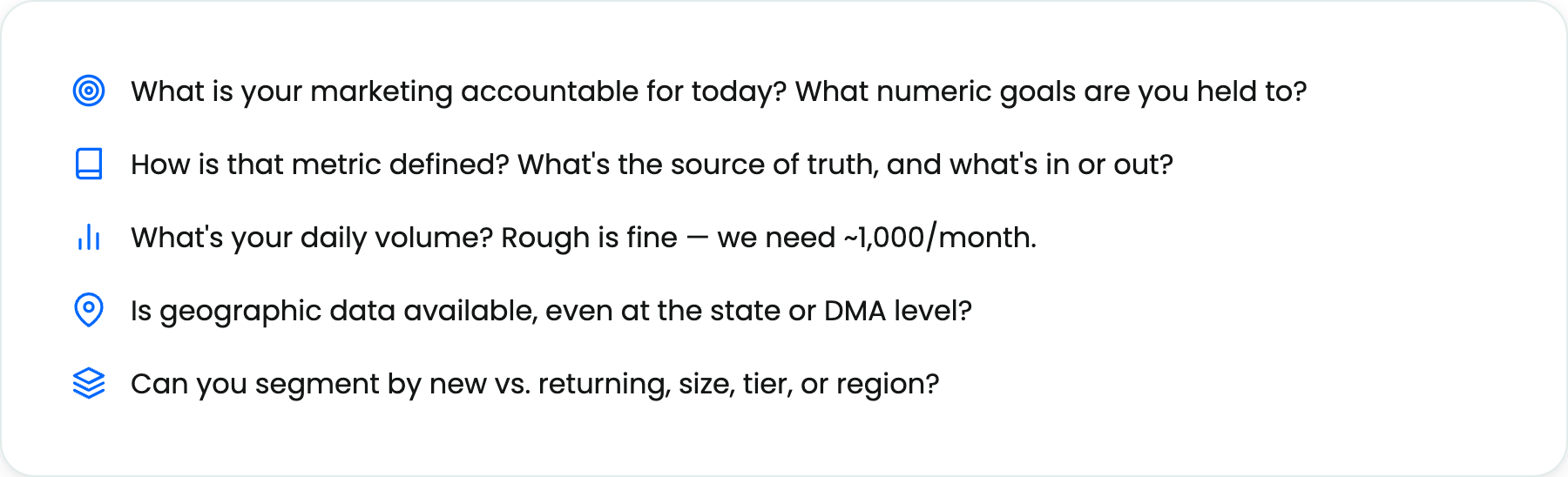
For a deeper treatment of this decision, see How to choose the right target metric for marketing measurement.
Your cost targets
We'll want to understand your current blended cost-per on your target metric and any internal targets you're measuring against. This lets us validate the model results and design experiments with realistic budget assumptions.
You don't need precision. A range is enough: "Our current blended CPA is roughly $80, and our target is $60."
Your marketing channels & spend per channel
Map your full mix. We'd rather know about a channel and decide it's too small to include than miss one that matters.
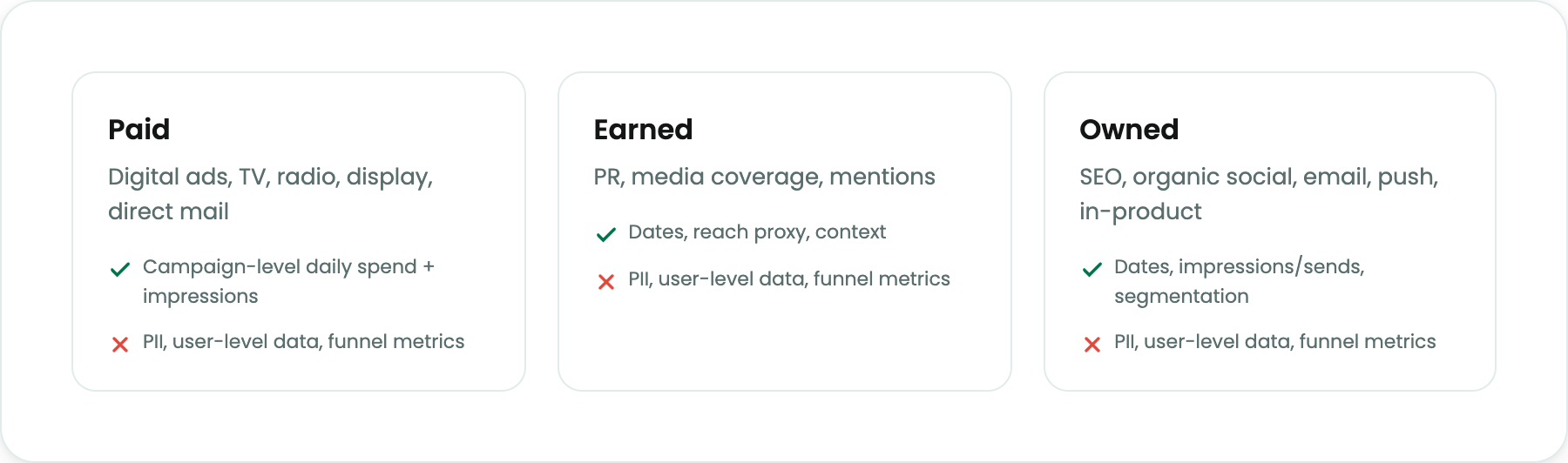
Please leave funnel and lifetime metrics out of your marketing channel data. MMM measures incrementality from the relationship between spend, impressions, and your target metric. Per-channel funnel data has no role in the model.
A few specific notes that catch people out:
Google Search almost always needs to be split into brand and non-brand. They behave completely differently in the model. More in How granular should your channels be in your MMM?.
Channels under ~1% of total spend are usually too small to break out. We'll either bundle or exclude them, and your Growth Advisor will talk you through it.
Zero-spend channels like SEO and organic social can still go in the model. See How to think about zero-spend channels in your MMM.
Business context beyond metrics and channels
There are factors that shape the model but often don't come up if not directly asked:
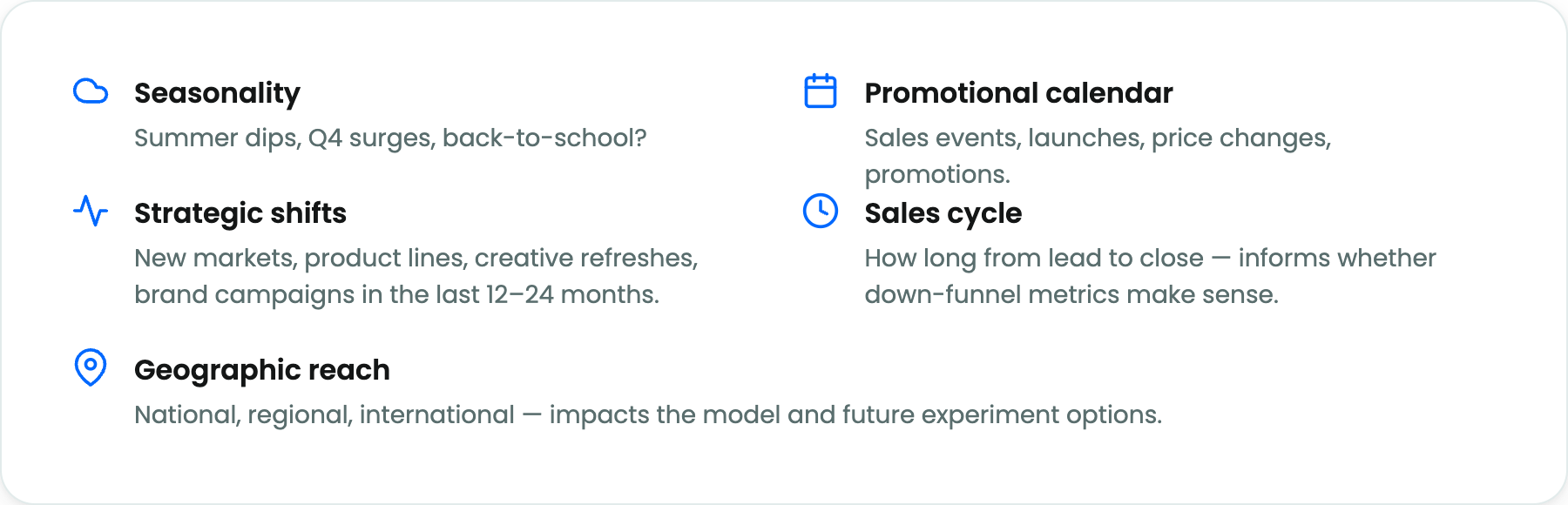
Your Growth Advisor will bring these up in kickoff, but thinking about them ahead of time makes the call faster and sharper. Additional resources around Seasonality and Promotional calendars for your reference.
Sharing data with Paramark
In parallel with the kickoff call, you'll have a data onboarding call with Paramark. The key here is to get your data flowing. There may be some data engineering work required on your side. Paramark is happy to connect directly with your data team and handle the details with them.
What marketing channel data we need
For each paid channel, we need daily, granular data going back 18-24 months or more if available. As a rule of thumb, channel or campaign buckets generally need to represent at least 1% of your overall ad spend to be worth breaking out. Below that, they add noise without signal (more detail on channel granularity). Please see the below schema examples:
How often should you share impressions and spend? Daily is preferred whenever you can provide it, because it gives Paramark the cleanest view of timing and improves the quality of analysis. Weekly data can still be workable for some channels or temporary onboarding situations, but if you are able to switch from weekly to daily sharing, that is usually helpful.
If you are planning a temporary change in cadence — for example, sharing daily data during a specific month such as September — please tell your Growth Advisor which channels are changing, when the new cadence will start, and whether the change is temporary or permanent. That helps Paramark interpret the data correctly and avoid confusion when reviewing trends.
Schema Examples
Sample business target metric for B2B leads
Example schema for a B2B business target metric of new leads.
Column Name | Type | Description |
Date | Date | Date of new lead |
What happens right after the kickoff call?
Right after kickoff, Paramark usually sends a recap with the goals, the agreed measurement focus, and the immediate next steps. In most cases, the next practical step is to schedule the data onboarding session and identify who on your team will provide the first data exports or access.
A useful post-kickoff handoff usually includes:
The kickoff recap and any recording or notes so the broader team can align on what was discussed.
A short list of the first files, exports, or access steps needed from your side, such as older spend history, a current raw export, or the owner for each data source.
A scheduled data onboarding meeting with the people who own marketing data, platform access, or warehouse tables.
Any channel-specific caveats that came up in kickoff, such as where impressions are not available and another proxy metric may be needed instead.
If some channels use different delivery signals — for example spend for one channel, video views for another, or sends for email — that is normal. The important thing is to flag those differences early so Paramark and your team can align on the best available proxy during data onboarding rather than discovering the gap later in model review.
Questions?
Your Growth Advisor is your first call at every stage of onboarding. You'll have a dedicated Slack channel where you can ask anything, flag blockers, or get a quick read on whether something is on track. We'd rather hear a small concern early than catch a big one late.
If you're wondering whether there will be data to review tomorrow and what the meeting agenda will be
It is common for a customer to head into an onboarding or working session before all data access is fully live. If that happens, the meeting can still be productive.
In most cases, if your data is not fully available yet, Paramark will use the meeting to:
confirm what data is already accessible and what is still blocked, missing, or awaiting internal approval
align on the agenda for the first real data review, including which sources, metrics, geographies, and channel cuts we want to inspect once access is complete
review your immediate business questions so we know what decisions the first analysis needs to support
outline the next steps and owners for getting the remaining tables, files, or permissions over the line
If the data is already flowing in time for the meeting, we will usually spend the session reviewing what is available, checking whether the structure matches the agreed schema, and identifying any obvious gaps or anomalies before deeper analysis begins.
A simple way to think about the agenda is: what do we already have, what is still missing, what can Paramark review now, and what should happen next once the remaining data lands?
If you want the meeting to move faster, it helps to send your Growth Advisor a quick note before the session with any newly shared tables, screenshots, links, or updates on blockers. That makes it easier for Paramark to spend the live time on decisions rather than status collection.