What Is "Baseline" in Marketing Mix Modeling (MMM)?
Last updated: September 11, 2026
When marketers look at MMM results, one of the most common questions is: "What exactly is baseline?" It’s a foundational concept and understanding it helps you interpret model results correctly.
The simple definition
Baseline is the [output metric volume] your business would have received without marketing efforts that are accounted for in the MMM (noting that channels that are not included in the MMM would be included in the baseline).
The baseline vs. incremental sales
MMM splits your total sales into two parts:
Baseline sales: The expected volume without marketing. Driven by brand, habit, and long-term factors.
Incremental sales: The additional volume driven by marketing activities like TV, paid search, social, promotions, etc.
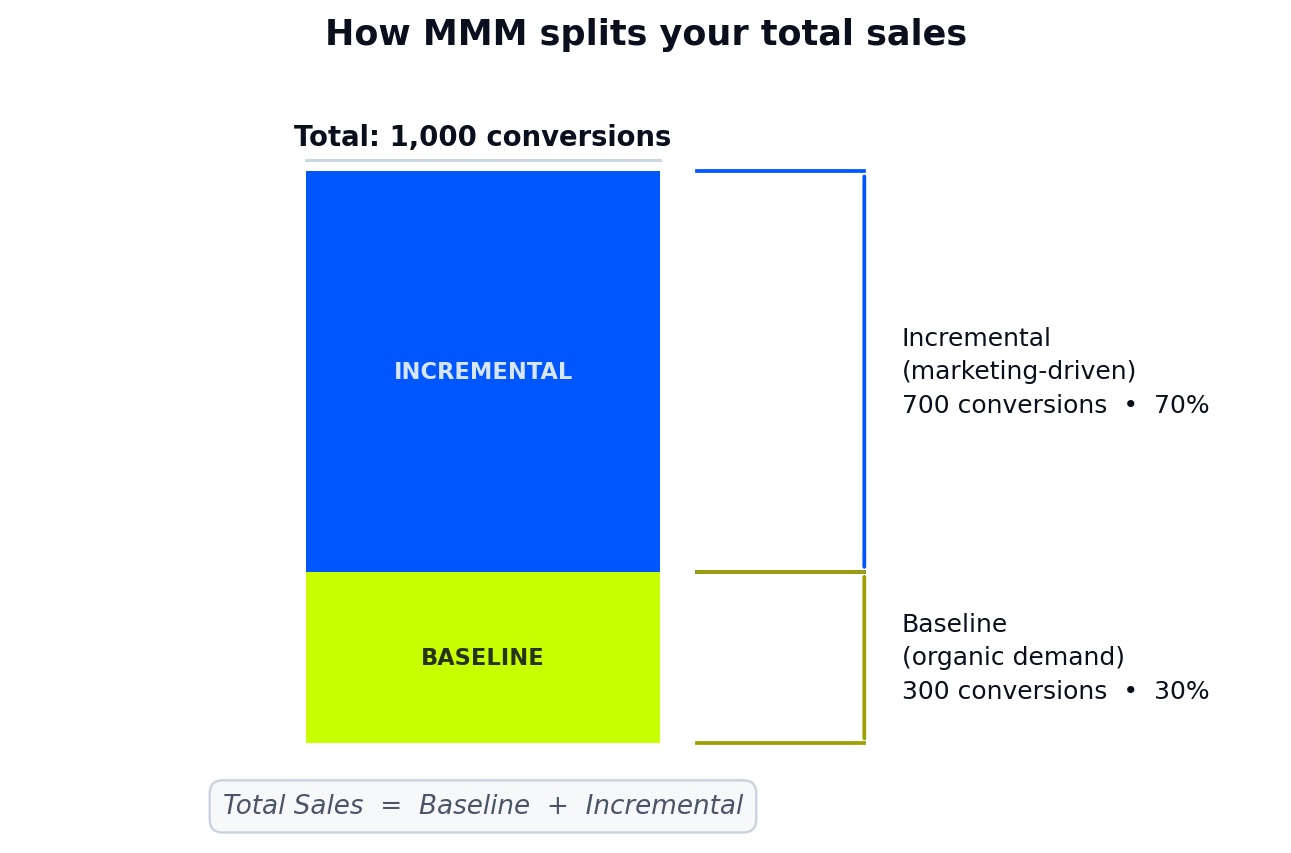
Mathematically:
Total Sales = Baseline + Marketing-Driven (Incremental) Sales
Why baseline matters
It anchors your model. Without a baseline, you can’t estimate incremental impact.
It tells you brand health. A strong baseline means your brand has strong organic demand—even before spending.
It helps in budget decisions. Knowing how much of your sales are organic vs. marketing-driven helps you understand diminishing returns and optimize spend.
What drives baseline changes over time
Baseline isn’t fixed. It evolves based on factors that are long-term or outside immediate marketing control, like:
Brand awareness and loyalty growth
Product availability and distribution
Word of mouth or earned media
Pricing or product changes
Economic conditions or seasonality
How MMM estimates baseline
MMM uses statistical models (like regression) to separate the influence of marketing variables from everything else. What’s left—after accounting for paid media, promotions, and other measured factors—is the baseline. It’s often modeled with variables that capture long-term patterns, such as:
Seasonality terms (e.g., holiday uplift)
Trend variables (e.g., steady growth over time)
Control variables (e.g., economic indicators, distribution)
A simple analogy
Imagine your sales as a river. Marketing campaigns are like rainstorms that cause temporary surges. The baseline is the steady flow of the river when it’s not raining. Over time, that flow can rise or fall—but it’s always there, even when no marketing is happening.
Common misunderstandings
Baseline isn’t “free” sales. It’s built on the back of years of marketing and brand investment.
Baseline isn’t constant. It can grow (brand momentum) or shrink (competitor entry, loss of relevance).
Baseline isn’t easily observable. It’s inferred statistically, not directly measured.
FAQs About Baseline and Incremental
1. How do you determine what goes into baseline vs. incremental?
Baseline represents the portion of performance explained by non-marketing factors such as seasonality, trends, brand equity, and macroeconomic conditions. Incremental represents the lift explained by marketing spend and efforts modeled in the MMM. Practically, baseline is “what’s left” after accounting for the modeled marketing effects.
2. How is baseline calculated in practice?
This is a vastly simplified explanation for a marketing team. After estimating how much each channel contributed (incremental), MMM subtracts that from total observed outcomes. The remainder is the baseline. For example, if total conversions = 1,000 and marketing-driven conversions = 700, the baseline = 300.
3. Can untracked channels affect the baseline?
Yes. If certain marketing efforts (e.g., affiliates, referrals, events) aren’t captured in the model, their impact gets absorbed into the baseline. This is why clear data coverage is critical.
4. What influences whether baseline or incremental dominates?
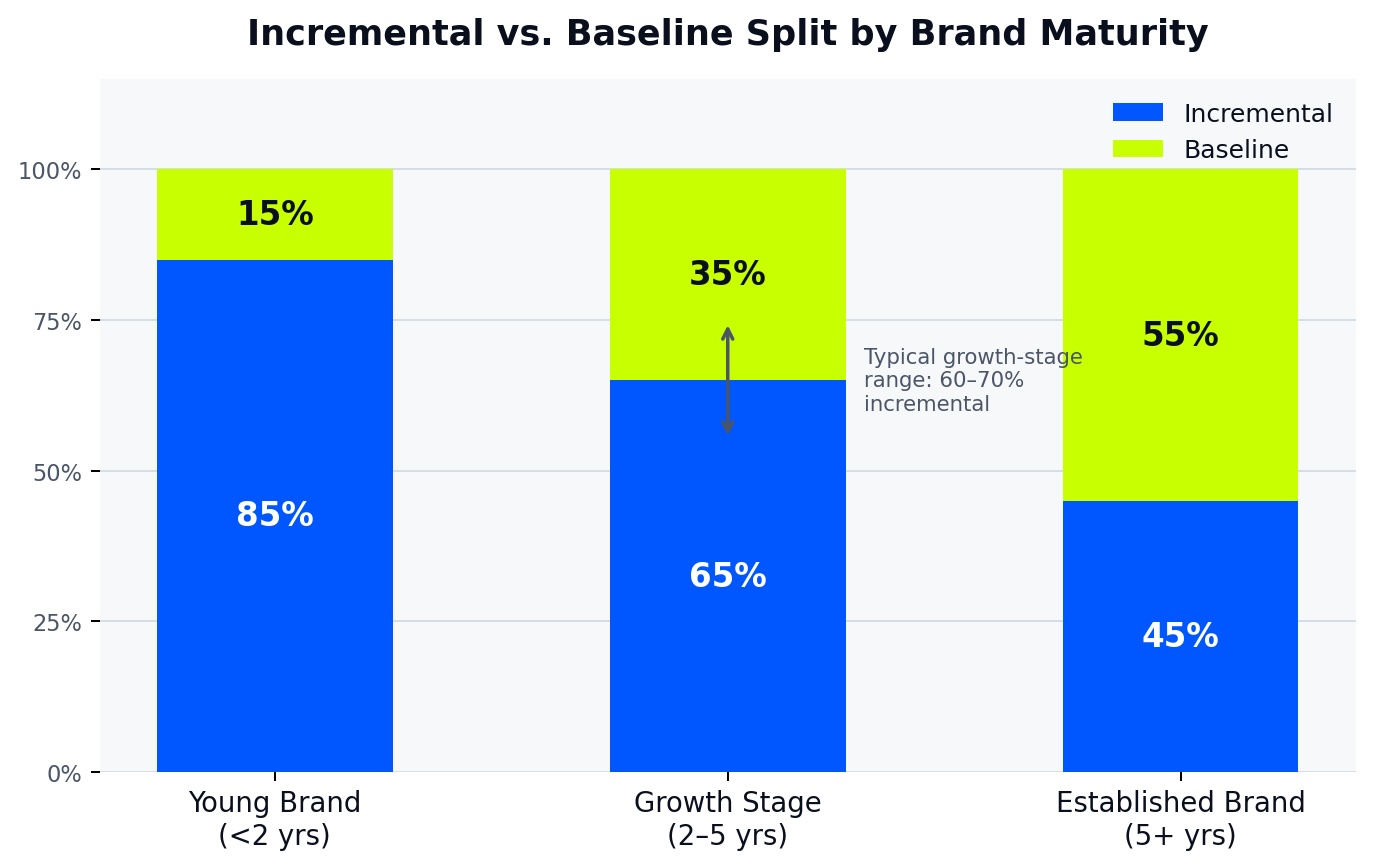
Brand maturity: Mature brands tend to have higher baselines. Newer brands rely more on marketing to drive sales.
Spend levels: Heavy direct-response spend drives incremental up.
Brand marketing: Increases baseline gradually over time.
Seasonality and competitors: Both can temporarily shift baseline levels.
5. What’s a “good” split between baseline and incremental?
There’s no universal benchmark, but typical patterns are:
Growth-stage brands: 60–70% incremental
Mature brands: 10–30% incremental
New brands: up to 90% incremental
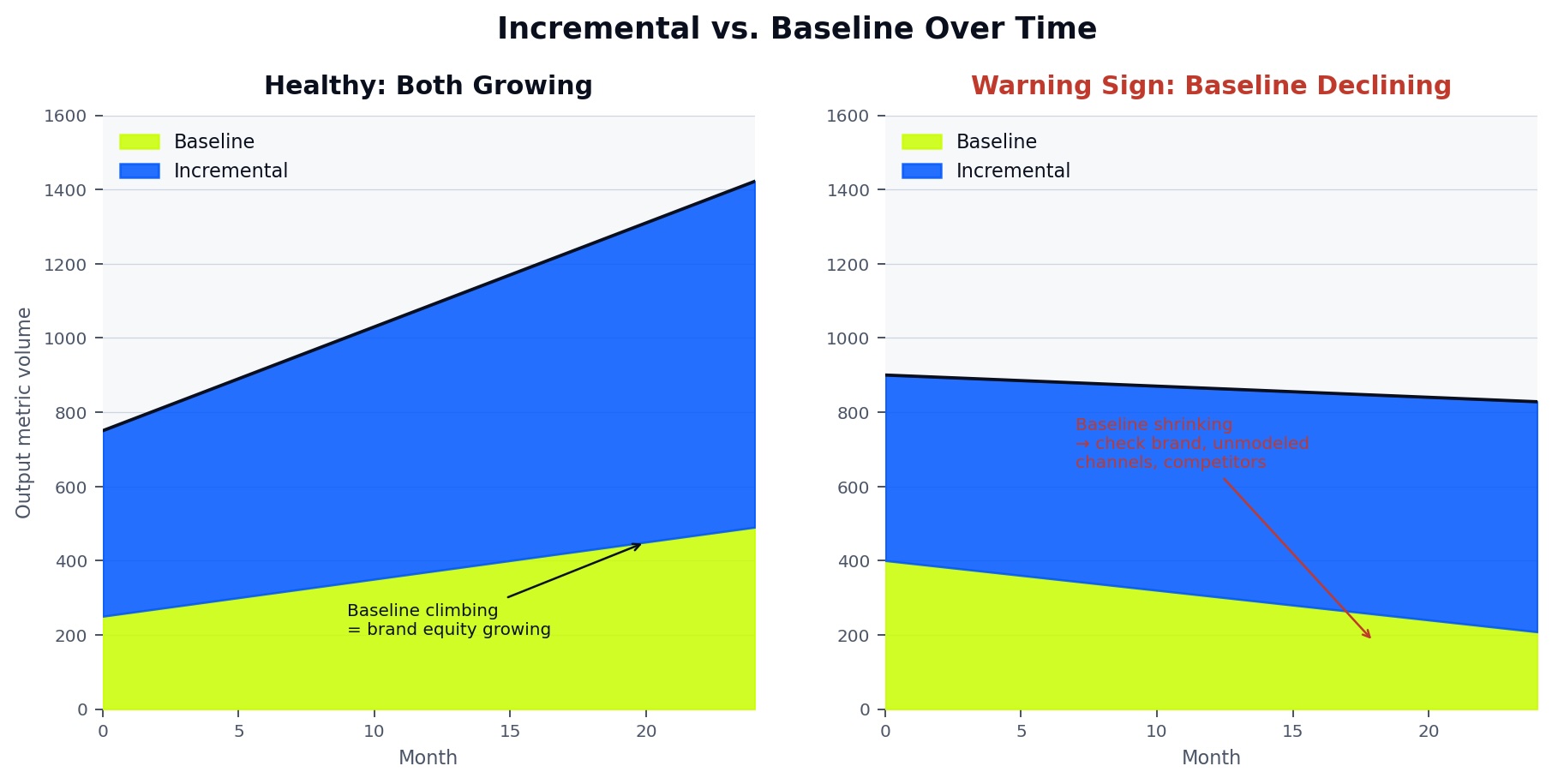
The key is whether both baseline and incremental are growing in absolute terms.
5a. If more than 90% of my conversions are attributed to paid channels, should I interpret the remaining baseline as "organic"?
Broadly, yes: if your report shows that more than 90% of conversions are incremental, then the remaining baseline is the portion the model believes would have happened without the paid marketing captured in the MMM. That usually includes organic demand, repeat behavior, brand momentum, word of mouth, seasonality, and any other non-marketing or unmeasured factors.
Two important caveats: baseline is not the same thing as a last-click Organic channel in analytics, and it is not a pure measure of SEO or direct traffic. It is a model construct representing everything not attributed to the measured channels. So if baseline is under 10%, the right interpretation is usually "the model is attributing less than 10% of total conversions to non-measured / non-incremental drivers, and more than 90% to modeled marketing activity" — not necessarily "only 10% came from my Organic reporting channel."
If that split feels surprisingly extreme, the first things to check are whether any meaningful channels or business drivers are missing from the model and whether the time period reflects an unusually promotion-heavy or spend-heavy period for the business.
6. My baseline is declining—should I worry?
Not always. Check for:
Lower spend or channel coverage issues
Reduced brand marketing or earned media
Strong competitor activity
Seasonal changes
If those are stable, a falling baseline may indicate weakening brand equity.
7. My incremental is declining—does that mean marketing isn’t working?
Not necessarily. It could reflect:
Creative fatigue (ads need refreshing every few months)
Targeting saturation (audience overlap or exhaustion)
Seasonal factors or competitive noise
Budget misallocation
Evaluate campaign efficiency, not just topline incremental volume.
8. What’s the ideal trend over time?
Ideally, both baseline and incremental rise together—your marketing builds long-term growth (raising baseline) while continuing to drive short-term growth (incremental). That’s sustainable performance: up and to the right. The percentages for baseline and incremental may fluctuate but the volumes should continue to increase over time.
9. What's the difference between baseline and the intercept?
The intercept is one component of baseline, not the same thing. Baseline is the aggregate of everything the model doesn't attribute to your measured marketing channels: the intercept, plus trend, plus seasonality, plus any macro variables, plus unexplained residual. When you see "baseline" in your results, it means the full sum — not the intercept term alone.
10. My baseline dropped dramatically in one month. What does that mean?
A dramatic baseline drop almost always means something significant happened to your business in that period that marketing did not cause, and the model did not have data to explain it. The model did not make an error. It reflected a real change by attributing the unexplained gap somewhere.
The most common trigger is a month where your target metric declined while marketing spend stayed roughly flat. Without external data to account for the drop (a macro event, a pricing change, a competitor move, a regulatory shift), the model absorbs the unexplained volume away from your channels. What remains lands in baseline.
Your Growth Advisor can work with you to identify what happened in that period and incorporate it as a model input. Once the model can account for the external influence, the baseline percentage normalizes in the next refresh. In the meantime, the channel-level efficiency rankings remain valid and actionable even while baseline is being recalibrated — those rankings are driven by how channels perform relative to each other, not by the baseline number.
11. My baseline is very high (60% or more). Does that mean marketing isn't working?
No. A high baseline is not a warning sign. It is typically a reflection of a mature brand with strong organic demand.
Baseline captures all the volume that comes from non-marketing sources: brand recognition built over time, repeat customers, word of mouth, and structural market demand. A 60%+ baseline means most of your conversions are coming from those accumulated factors. The remaining portion is what your current marketing is driving on top of that base. Marketing is still contributing. The model is simply being precise about what is doing the work.
A brand that generates 60% of its volume organically and 40% through active marketing is in a strong position, not a weak one. If the number feels surprisingly high, it is worth checking whether any significant volume drivers are missing from your model. Channels not included in the MMM (affiliates, events, referrals, brand sponsorships) flow into baseline. If any of those are large and recently changed, they could be influencing the percentage.
Want to learn more about marketing mix modeling? Check out other Paramark marketing mix modeling articles here