What is Marketing Mix Modeling?
Last updated: April 16, 2026
Introduction
Marketing Mix Modeling (MMM) is a marketing analytics technique that helps you figure out how different channels and tactics contribute to sales. By analyzing historical marketing activity, spend and performance data, MMM can attribute portions of your sales to specific marketing activities. Modern MMM uses advanced machine learning to improve accuracy (capturing effects like delayed impact of ads) and is often combined with incrementality testing (experiments) for better confidence in the results. This guide explains the basics in a non-technical way, aimed at marketing teams.
What is Marketing Mix Modeling (MMM)?
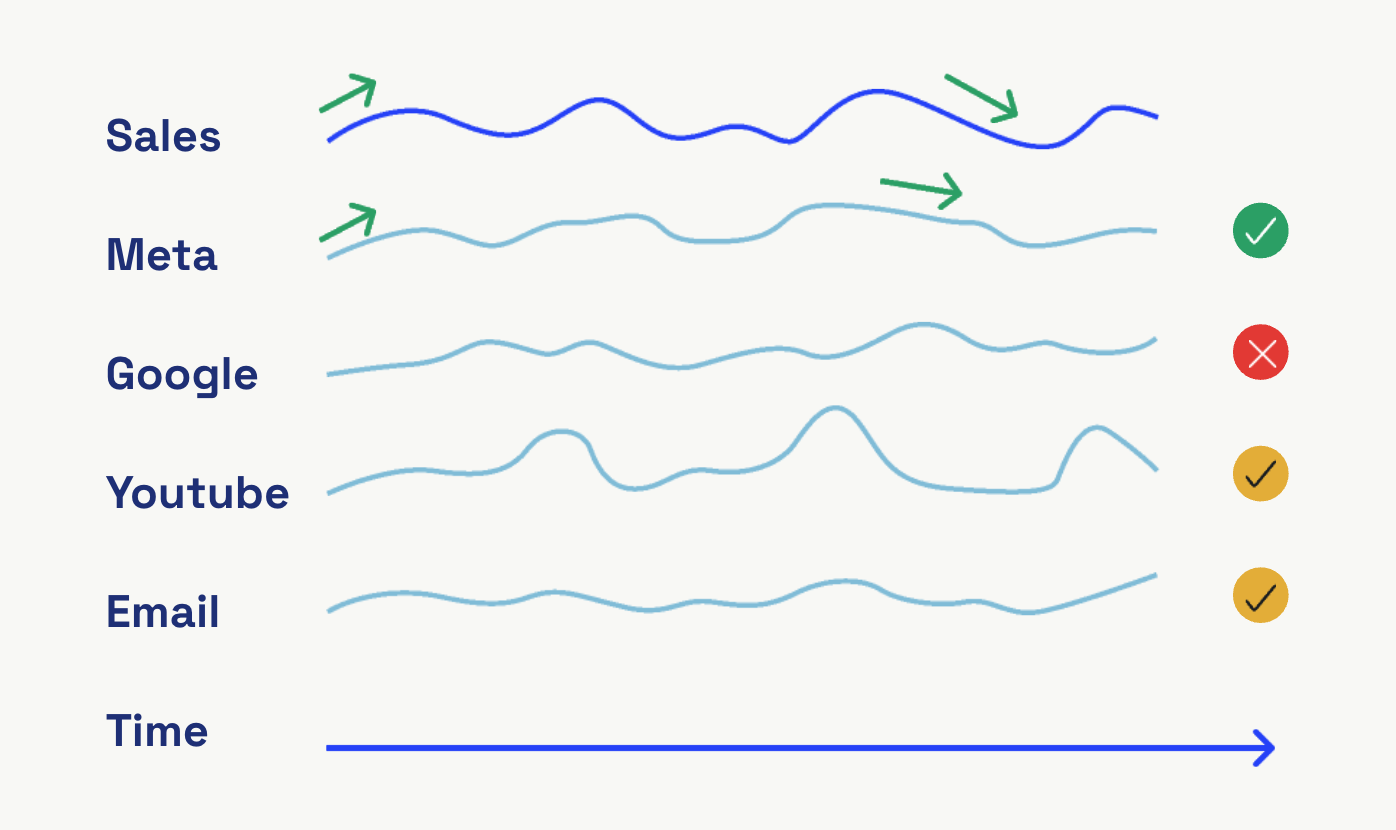
Marketing Mix Modeling (MMM) is a statistical analysis approach used to measure the impact of various marketing efforts on sales or other key performance indicators . In practice, MMM examines historical data (typically time-series data of marketing spend, impressions, clicks, etc. alongside sales figures) and uses regression or other modeling techniques to estimate how much each marketing channel or factor is contributing to sales. The result is essentially a data-driven “recipe” for your sales – showing how different ingredients (marketing channels, pricing, seasonality, etc.) have mixed to drive revenue.
Some key points about MMM:
Holistic and Aggregate: MMM looks at all marketing channels together over time, rather than single touchpoints. It works on aggregated data (e.g. weekly TV spend, monthly social media spend, etc.), making it privacy-friendly and not reliant on user-level tracking.
Outcome-Focused: The model is usually set up to predict an outcome like total sales, revenue, or new customers, given the marketing inputs. By fitting a model to past data, MMM infers how changes in spend or activity would have changed the outcome.
Top-Down Attribution: Unlike user-level attribution models (which credit an individual sale to the last click or so), MMM provides a top-down view of what drives sales. It may factor in external influences (e.g. seasonality, economic conditions) and marketing activities, allowing marketers to separate the base sales (sales that would happen with no marketing) from the lift caused by marketing.
In essence, MMM gives you a high-level understanding of which marketing investments are paying off and how much they move the needle, using statistical evidence from your own historical data. It’s been used for decades by large advertisers and is now increasingly accessible to mid-sized companies as tools and expertise become more available.
Ultimately, MMM finds the correlation between each marketing channel and sales while accounting for the lag between impressions and contribution to sales.
Measuring the Impact of Each Marketing Channel
One of the most valuable outputs of MMM is a quantification of the relative impact of each marketing channel on sales performance. After running an MMM, you can usually see a breakdown of your sales and metrics like the ROI of each channel:
Sales Decomposition: The model will estimate how much of your total sales came from a “base” level (the sales you’d get with no marketing at all) versus the incremental sales driven by each marketing channel . For example, you might discover that in a given quarter, 60% of sales were base sales and the remaining 40% were incremental lift from marketing – with, say, 15% attributed to paid search, 10% to TV, 8% to social media, 5% to email, and 2% to other campaigns. This helps you understand which channels are punching above or below their weight.
ROI and Efficiency: Given the contribution of each channel and how much you spent on it, MMM can calculate the Return on Investment (ROI) or marginal ROI for each channel . In plain terms, ROI tells you “If I put $1 into this channel, how many dollars in sales (or profit) do I get back?” A channel with ROI greater than 1.0x is returning more sales than cost (good!), while an ROI below 1.0x means you spend more than it’s bringing in. This information is extremely useful for budget allocation – you might find, for instance, that Channel A has an ROI of 5.0x (very efficient) while Channel B is 1.5x. That implies Channel A is yielding more sales per dollar and maybe deserves a bigger budget, unless Channel A is already fully saturated (more on saturation later).
Comparative Effectiveness: MMM essentially puts all channels on a level playing field by evaluating their incremental contribution under the same conditions. It accounts for overlaps and interactions (to the extent the data allows), so you avoid double-counting. For example, if both social media and TV were running in the same weeks, the model can tease out how much each contributed by looking at patterns over time (when one was on/off or high/low) . This way, you get a clearer picture of what each channel truly adds to the bottom line, rather than simply looking at last-click attribution or platform-reported numbers which might over-credit certain channels.
With these insights, marketing teams can make more informed decisions. For instance, you might discover that a formerly undervalued channel (like tv or radio, perhaps) actually has a solid ROI and scales well, leading you to increase spend there. Conversely, you might find one channel dominating spend but only contributing a small fraction of incremental sales, suggesting a reallocation of budget. MMM essentially provides a data-backed attribution of sales to channels, guiding optimization of the marketing mix.
Accounting for Lagged Effects of Marketing (Adstock)
Marketing activities often do not produce all their impact immediately – there can be a lag between a marketing touch and its eventual impact on sales. For example, not everyone who sees your ad will run out and buy the product the same day. Some people might purchase days or weeks later, and some ads (like branding campaigns) build up consumer awareness that pays off over a longer period. MMM models take these lagged effects into account so that credit is assigned correctly over time.
Adstock (Carryover) Effect: In marketing analytics, the term “adstock” refers to the phenomenon where advertising continues to influence consumers for a while after the campaign has ended . Think of it as the residual impact or memory of your ads. For instance, imagine you run a big ad campaign for a new smartphone this week. Even in the weeks after the ads have stopped, consumers who saw them might still be thinking about the phone – some will later visit stores or search online as a result of that campaign. The impact of the ads gradually decays over time rather than dropping off instantly on the day the campaign ends . This carryover means week 2 and week 3 sales can still partly be driven by week 1’s advertising.
If an MMM ignored these lags, it might undervalue channels that have long-term effects (like TV). To handle this, MMM implementations include mechanisms to spread an ad’s effect across time. One common approach is using an adstock transformation: essentially applying a decay function to marketing spend variables so that a single week’s spend translates into a trailing impact over subsequent weeks . For example, a TV ad spend of $100k this week might be modeled as contributing, say, $60k worth of “equivalent spend” next week, $30k the week after, $15k the next, and so on (the exact pattern is determined by a decay rate that the model estimates from data). This way, if sales rise in week 2 or 3, the model can attribute some of that lift back to the earlier ads, rather than falsely crediting whatever campaign was running at that later time.
Accounting for lagged effects is crucial. MMM will often estimate a “decay rate” or retention rate for each channel – a higher decay rate means the channel’s impact drops off quickly (e.g. search ads might trigger immediate actions, so a lower carryover), whereas a lower decay (or a longer lag) means the channel keeps affecting people for longer (e.g. a memorable Super Bowl commercial could generate buzz and sales for months). By capturing these dynamics, MMM ensures that the timing mismatch between marketing and sales is properly aligned in the analysis. In practical terms, this means you can trust that the model isn’t naively assuming all spend works instantly; it knows, for example, that your Q1 marketing might be partly responsible for Q2 sales.
Modern Machine Learning: Improving Accuracy and Flexibility
Classic MMMs were often built with straightforward statistical techniques (like linear regression with a few manual adjustments). While effective, those models had to assume relatively simple relationships (often linear or with simple curve fits for saturation) and required a lot of analyst judgment to get right. Modern machine learning methods have significantly improved the accuracy and flexibility of MMM in several ways:
Non-Linearity and Saturation: Real-world marketing isn’t linear – doubling your budget on a channel usually doesn’t double the sales from that channel due to diminishing returns. Modern MMM approaches incorporate non-linear response curves for each channel, often learned from the data. For example, an MMM will output a response curve showing how additional spend on a channel yields progressively smaller incremental sales as you saturate the audience . These curves capture diminishing returns automatically, which makes the model more accurate at reflecting reality (you’ll see that after a certain point, extra spend might be better moved to another channel). In older models, analysts had to guess or impose a saturation curve; now machine learning can estimate it.
Bayesian Modeling and Priors: Many advanced MMM tools use Bayesian statistical methods (a modern approach popularized by Google in 2017 ) to improve accuracy. Without diving into technical detail, Bayesian MMM allows the model to incorporate prior knowledge or reasonable assumptions about marketing effectiveness, and it naturally provides probability distributions for each estimate (giving a sense of certainty). For example, you might inform the model that, historically in your industry, TV campaigns tend to have an ROI in a certain range – the Bayesian model uses this information as a guide (a “prior”) when fitting your data. This leads to more robust estimates especially with limited data . It helps prevent wildly implausible results that sometimes plague purely data-driven models when data is noisy. In short, the model can “know” something about the world before looking at your specific numbers, which makes its outputs more stable and credible.
Handling Complexity with Machine Learning: Machine learning algorithms (like advanced regression, decision trees, or gradient boosting) allow MMM to consider a larger number of variables and interactions without oversimplification. For example, ML-based MMM might evaluate dozens of potential factors (media spend, promotions, competitor activity, economic indicators, etc.) and automatically find which ones matter. It can also handle irregular effects (like a sudden spike due to a viral event) better by identifying patterns that classic methods might label as outliers. The flexibility of ML means models can be customized to each business – different functional forms can be fitted for different channels if needed (e.g. one channel might work with a saturation curve, another with a lag, another with both). This adaptability was harder to achieve in older MMM when everything had to be specified manually.
Faster Iteration and Granularity: What used to require lengthy consulting projects can now often be done faster with the aid of automated modeling. Modern MMM solutions can be updated monthly, ingesting new data and re-calibrating models continuously. They also can work at finer levels of granularity – for instance, providing insights at a group of campaigns or regions, not just channel level, if the data supports it. This gives marketers more actionable detail (for example, not just “Facebook ads ROI = 2x” but maybe “Facebook – prospecting campaigns ROI 1.5x vs retargeting campaigns ROI 3x”). Flexibility also means MMM can be tailored to different objectives or constraints; whether you’re an ecommerce business or a SaaS app, the modeling approach can adjust to your reality.
Overall, the infusion of modern ML techniques has made MMM more powerful and accessible. You get a model that better reflects real-world complexities (like carryover effects, diminishing returns, interactions) and can trust the recommendations more. This is why MMM has seen a resurgence even in today’s digital, data-rich environment – it’s evolving with the help of machine learning to remain a “trustworthy compass” for marketing strategy.
MMM and Incrementality Testing: A Powerful Combination
MMM is a great “big picture” tool – it looks at all your marketing in aggregate and tells you what’s driving sales on a macro level. However, by itself, MMM is based on observational data and statistical inference, which means it finds correlations that it interprets as contributions (with all the sophisticated adjustments discussed above to approximate causality). To strengthen confidence in those results, smart marketers combine MMM with incrementality testing.
What is Incrementality Testing? Incrementality tests are essentially controlled experiments (like A/B tests) designed to measure the actual causal impact of a specific marketing action. For example, you might run a hold-out test on a channel: hold back ads from a randomly selected group (the control) while showing ads to another group (the test), and then compare outcomes. This could be done via geo-testing (some regions see the ads, others don’t) or user-level randomization (if possible). The result of an incrementality test is a clear measurement of lift – e.g., “Running this campaign increased conversions by 20% compared to not running it”. In other words, it tells you how much of the result was truly incremental. Incrementality testing directly compares a treated group vs. a control group to see the difference in outcomes . It’s often considered the gold standard for causality in marketing measurement (when it’s feasible to do).
How MMM Benefits from Incrementality Tests: Rather than viewing MMM and experiments as either/or, the best practice today is to use them together, because they complement each other’s strengths and weaknesses. Here’s how they work in tandem:
Validation and Calibration: You can use results from incrementality tests to validate your MMM model’s findings. For instance, if your MMM suggests that a certain channel has an ROI of 3.0x, and you happen to have run a randomized experiment on that channel which found a similar lift-based ROI of ~3.0x, that increases trust in the MMM. If there’s a discrepancy, it flags that the model might need adjustment. In fact, modern MMM processes often include a step to calibrate the model using experiment data: essentially, feeding the known incremental lift from experiments into the modeling process so that the MMM’s attribution aligns with proven causal effects . One approach (in Bayesian MMM) is to use the experiment results as informative priors or constraints – for example, if a lift test shows channel X has an incremental conversion rate of around Y%, the MMM will be nudged to conform to that range . This way, the MMM is grounded in reality and less likely to over- or under-estimate a channel.
Continuous “Always-On” Measurement vs. One-Off Tests: Incrementality tests are typically point-in-time and siloed to one or two channels at a time – they give you deep insight into that channel/campaign under those specific test conditions . MMM, on the other hand, is always on (using ongoing data) and covers all channels together. By combining them, you get the benefit of both breadth and depth. MMM might show that, across the year, Channel A drove the most incremental sales overall. An incrementality test on Channel A, run for a month, might tell you how much lift to expect if you pause Channel A or the lift from increasing spend by X%. Together, these inform both strategic allocation (thanks to MMM’s big picture) and tactical decisions (thanks to experiment evidence).
Improving Incrementality Tests with MMM Insights: The knowledge flows the other way too. MMM might reveal interesting findings that you then want to double-check with an experiment. For example, MMM could indicate that a new advertising format (say, a new social platform) appears very effective. You might then run an incrementality test on that platform to verify its true impact in a controlled way. If the test confirms it, great – you can invest more confidently. If not, you recalibrate expectations. In this manner, MMM can help prioritize which incrementality tests to run by pointing to the channels or tactics where there’s uncertainty or big potential.
In summary, MMM and incrementality testing together create a robust measurement ecosystem. MMM provides a comprehensive, long-term view of performance across all channels (accounting for interactions and external factors), while incrementality tests provide ground-truth causal validation for individual elements. Using both, you as a marketer get the most reliable guidance – you’re basing decisions on a model that is informed by real experiments, and you’re scaling the reach of those experiments’ learnings to your entire marketing mix. This combination reduces the guesswork and gives stakeholders greater confidence in the attribution of marketing impact.
Want to learn more about marketing mix modeling? Check out other Paramark marketing mix modeling articles here
Further Reading
For those who want to dive deeper into Marketing Mix Modeling and advanced measurement, here are a few recommended resources:
Academic Paper (Google Research) – “Bayesian Methods for Media Mix Modeling with Carryover and Shape Effects” by Yuxue Jin et al. (2017). This paper introduces a modern Bayesian approach to MMM, including how to model lagged (carryover) and saturation (diminishing returns) effects.
Industry Article (Harvard Business Review) – “A New Gold Standard for Digital Ad Measurement?” by Julian Runge, Harpreet Pattar, and Igor Skokan (March 2023). A practitioner-friendly discussion of evolving marketing measurement techniques, including MMM and the use of experiments to improve models .